Let me ask you something. Have you ever wondered if AI agents could actually replace you? Or maybe you've wondered if they're even worth the hype?
If you're like most digital marketing professionals, the answer is: "Yes. I'm not sure what they can really do." The hype around AI agents is everywhere. But separating reality from exaggeration is hard.
In this guide, I'll give you a clear, honest breakdown of what AI agents can do for you vs what they can't. Whether you're a digital marketing professional, a business owner, or a student taking a digital marketing course, this is your reality check on AI agents.
Let's dive in.
1. What Is an AI Agent?
Before we get into what they can and can't do, let's define what an AI agent actually is.
1.1 The Definition
An AI agent is an autonomous system that perceives its environment, reasons about it, and takes action to achieve a goal. Unlike a simple chatbot, an agent can plan, execute, and learn—without constant human supervision.
1.2 How It Works
- Perceives: Gathers information from its environment
- Reasons: Processes information and makes decisions
- Acts: Takes actions to achieve goals
- Learns: Adapts and improves based on feedback
1.3 What They're Not
An AI agent is not just a chatbot. It's not a simple automation tool. And it's definitely not a human replacement. It's a tool that can operate with more independence than traditional software.
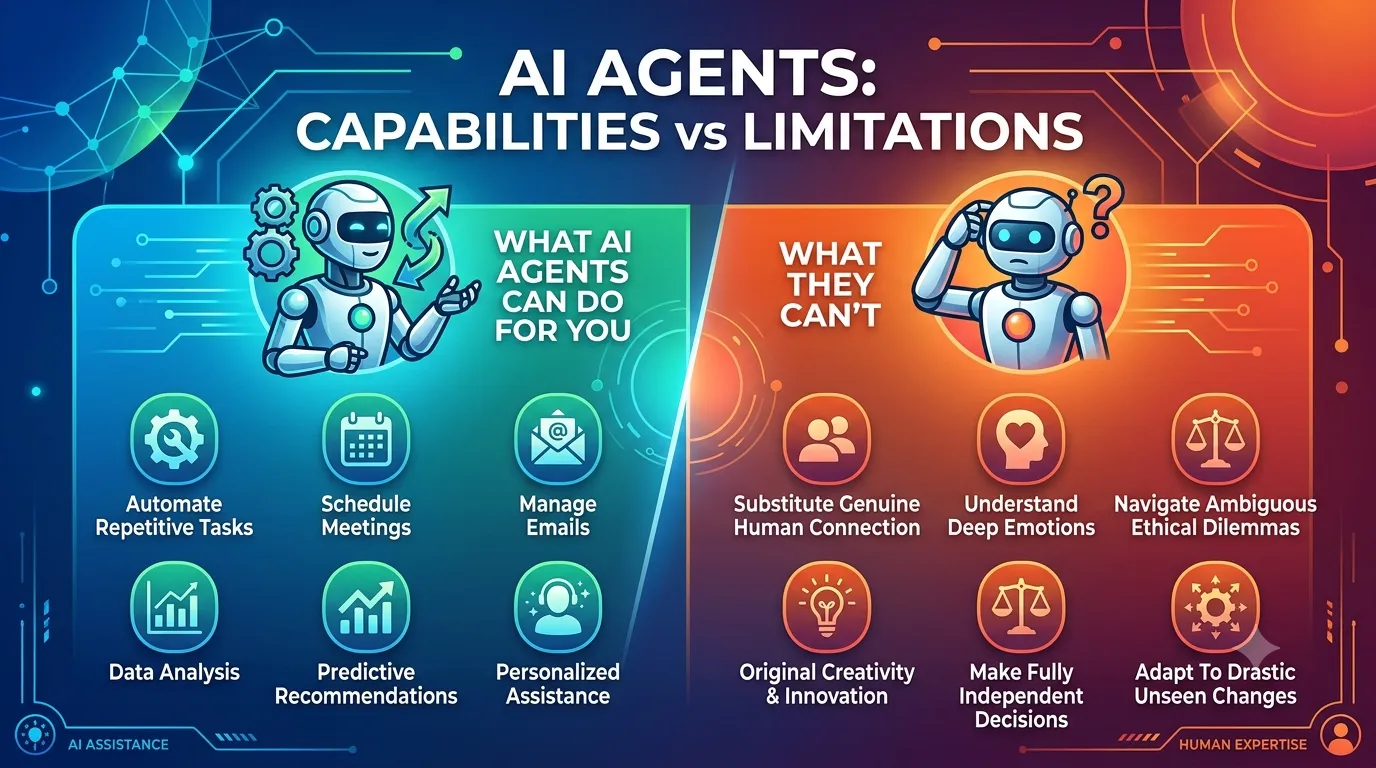
2. What AI Agents CAN Do for You
Here's a practical look at what AI agents can actually do.
2.1 Handle Repetitive Tasks
AI agents are excellent at repetitive, routine tasks. They don't get bored, tired, or distracted. They can handle data entry, scheduling, email sorting, and other repetitive work without complaint.
Example: An AI agent can automatically sort and categorize incoming emails, flagging important ones for human attention.
2.2 Process Large Volumes of Data
AI agents can analyze massive amounts of data in seconds. They can identify patterns, trends, and anomalies that humans would miss.
Example: An AI agent can analyze customer feedback across thousands of reviews and identify common themes.
2.3 Automate Workflows
AI agents can manage entire workflows from start to finish. They can coordinate tasks, route information, and trigger actions across multiple systems.
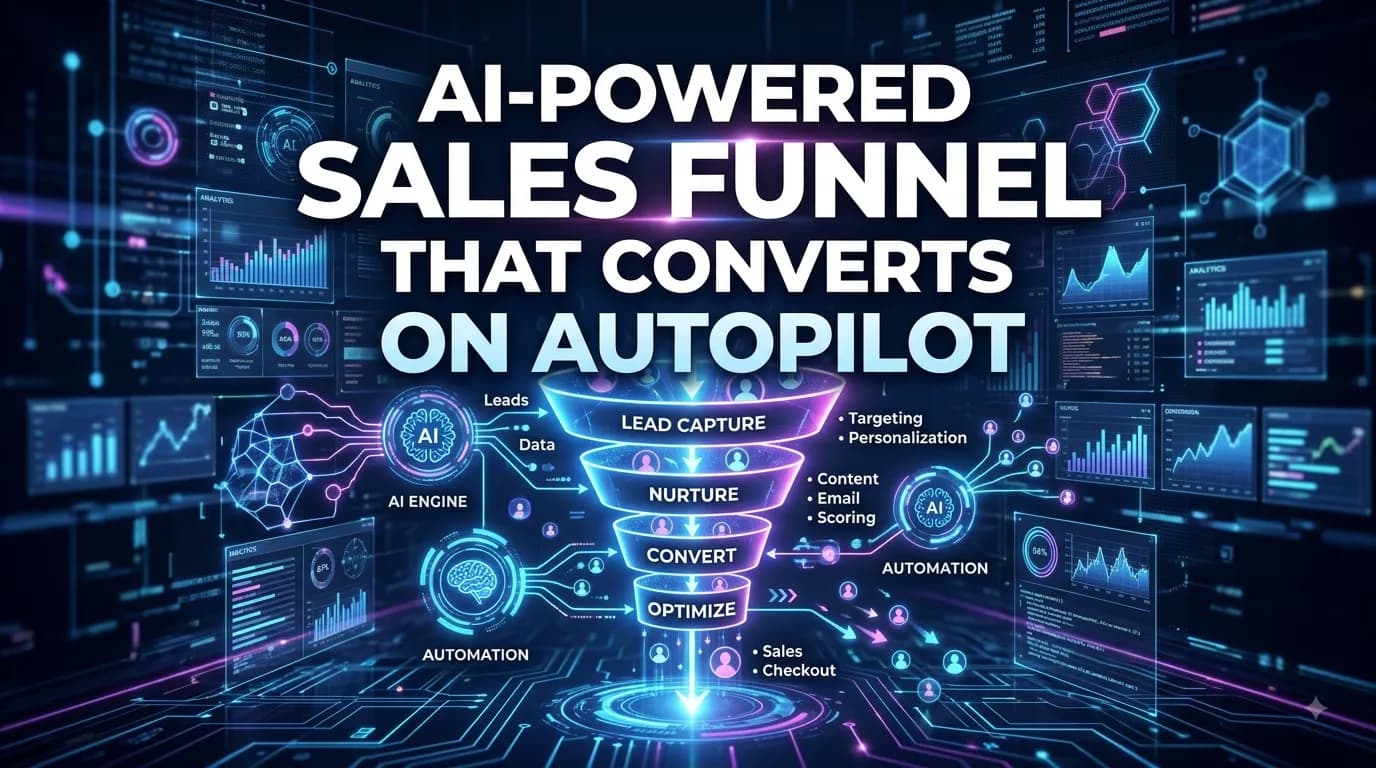
Example: An AI agent can manage a lead generation workflow—capturing leads, scoring them, sending nurturing emails, and escalating warm leads to sales.
2.4 Personalize Customer Interactions
AI agents can deliver personalized experiences at scale. They can tailor content, recommendations, and communications to individual users based on their behavior and preferences.
Example: An AI agent can send personalized email recommendations based on a customer's browsing and purchase history.
2.5 Monitor and Alert
AI agents can monitor systems, data, and activities 24/7. They can detect issues, anomalies, and opportunities and alert humans when needed.
Example: An AI agent can monitor social media mentions and alert you when your brand is mentioned.
2.6 Generate Content at Scale
AI agents can generate large volumes of content—drafts, outlines, summaries, and variations. They can produce consistent, brand-aligned content faster than any human team.
Example: An AI agent can generate 50 variations of ad copy for A/B testing.
3. What AI Agents CAN'T Do (Yet)
Now let's be honest about their limitations.
3.1 Build Genuine Emotional Connections
AI agents can mimic empathy, but they don't feel it. They can respond in ways that seem caring, but they don't truly understand or share emotions. Real human connection requires genuine understanding.
Why it matters: In sales, leadership, and customer relationships, emotional connection is essential. AI can't replace it.
3.2 Make Ethical Judgments
AI agents have no moral compass. They don't understand right and wrong, fairness, or justice. They can be biased, unfair, and harmful if not carefully monitored.
Why it matters: Decisions involving ethics, fairness, and human impact require human judgment. You can't delegate these to machines.
3.3 Understand Nuance and Context
AI agents struggle with nuance, sarcasm, cultural context, and emotional subtext. They can misinterpret communications and respond in ways that are tone-deaf.
Why it matters: Marketing, customer service, and leadership require understanding of context and nuance. AI often misses these subtleties.
3.4 Take Real-World Action
AI agents are digital—they can't interact with the physical world. They can't pick up a phone, attend a meeting, shake a hand, or build real-world relationships.
Why it matters: Business is built on real relationships. AI can support them, but it can't replace them.
3.5 Be Truly Creative
AI agents are remixers, not creators. They can combine existing ideas in new ways, but they can't generate truly novel, breakthrough ideas that challenge existing paradigms.
Why it matters: Innovation, brand building, and market leadership require original thinking.
3.6 Take Accountability
AI agents don't get fired, sued, or blamed. When things go wrong, the responsibility falls on humans. You're accountable—not the AI.
Why it matters: You're responsible for every output, decision, and outcome. AI is just a tool.
3.7 Understand "Why" (Only "What")
AI can tell you what to do, but it can't explain why in a meaningful way. It can't understand causality, purpose, or meaning. It processes patterns—it doesn't understand significance.
Why it matters: Strategy requires understanding the "why." AI can't provide that.
4. The AI Agent Reality: What's Actually Possible Today
Here's a practical breakdown of what you should actually expect.
4.1 What's Working Well
- Automation: AI agents are excellent at automating routine tasks and workflows.
- Data processing: They can analyze massive amounts of data quickly.
- Content generation: They can produce large volumes of consistent content.
- Personalization: They can deliver tailored experiences at scale.
4.2 What's Not Working Yet
- Emotional intelligence: AI still struggles to understand and respond to human emotions.
- Ethical reasoning: AI lacks a moral compass and can't make ethical judgments.
- True creativity: AI remixes existing ideas—it doesn't create breakthrough concepts.
- Accountability: AI doesn't take responsibility for outcomes.
5. The Human-AI Partnership Model
The most effective approach is the human-AI partnership. Here's how it works.
5.1 AI Handles:
- Repetitive, routine tasks
- Data processing and analysis
- Content generation and scaling
- Personalization at scale
- Monitoring and alerting
5.2 Humans Handle:
- Strategic thinking and decision-making
- Emotional intelligence and connection
- Ethical judgment and responsibility
- Creativity and innovation
- Relationship building
- Accountability
5.3 The Result
When AI handles execution and humans handle strategy, you get the best of both worlds—efficiency, scale, and human insight.
6. Real-World Example: The AI Agent in Marketing
Here's how a digital marketing agency uses AI agents effectively:
- AI agent does: Content drafting, social media scheduling, email sequencing, data analysis, lead scoring
- Humans do: Strategy development, creative direction, client relationship building, campaign oversight, final approvals
- Result: 3x more output, higher quality, and stronger client relationships
7. Conclusion: Use AI for What It's Good At—Stay Human for the Rest
AI agents are powerful tools. They handle repetitive tasks, analyze data, and generate content at scale. But they can't build emotional connections, make ethical judgments, or take accountability.
But here's the good news: You don't need AI to do everything. Use AI for what it's good at—and stay human for the rest. The most effective approach is the human-AI partnership.
The choice is yours. Expect AI to do everything, or partner with it to do what you do best.
Join the best Digital Marketing Course to master AI-powered marketing and digital strategy in 2026.
Frequently Asked Questions (5 Unique FAQs)
❓ 1. Can AI agents replace human workers entirely?
No. AI agents can handle routine tasks, but they can't replace the strategic thinking, emotional intelligence, creativity, and accountability that humans provide. The most effective approach is the human-AI partnership.
❓ 2. What's the biggest limitation of AI agents?
Emotional intelligence. AI agents can mimic empathy, but they don't truly understand or share human emotions. This limits their effectiveness in sales, leadership, and customer relationships.
❓ 3. Can I trust AI agents to make decisions?
It depends on the decision. AI agents can make data-driven decisions for routine tasks. But for strategic, ethical, or high-stakes decisions, human judgment is essential.
❓ 4. How do I know if a task should be handled by AI or a human?
Ask: Does this task require emotional intelligence? Ethical judgment? Creativity? Relationship-building? If yes, a human should handle it. If it's routine, repetitive, or data-driven, AI can handle it.
❓ 5. Will AI agents eventually overcome these limitations?
Some limitations will be reduced over time—like reasoning and context understanding. But some are fundamental: AI will never truly feel emotions, take accountability, or understand the meaning of "why." These are inherently human capabilities.